Most accounting firm business plans fail before the ink dries — not because they’re poorly written, but because they’re built on estimates instead of evidence. Here’s how to build one that actually works.
The Problem With Most Accounting Firm Business Plans
Ask ten accounting firm owners if they have a business plan. Most will say yes. Ask how often they look at it, and most will go quiet.
The plan exists. It might even be well-written. But somewhere between drafting it and running the firm day to day, it stops being useful.
There are plenty of reasons a business plan stops being useful — it gets written once and never revisited, the goals are too vague to act on, or it lives in a folder no one opens. But one of the most common and most fixable is this: the plan was built on estimates. Revenue goals based on rough assumptions. Capacity projections built from gut feel. Profit margins guessed at rather than calculated. When the numbers in your plan don’t connect to the actual numbers in your firm, there’s no feedback loop — and a plan without a feedback loop is just a document.
This guide is about building an accounting firm business plan differently — one that starts with honest data, sets goals you can track, and stays connected to how your firm actually operates. Whether you’re writing a CPA firm business plan for the first time or overhauling one, the process is the same: start with what’s real, set goals that are specific, and build the infrastructure to measure both.
What Your Business Plan Needs to Actually Accomplish
A business plan for an accounting firm isn’t a funding document. It’s a management tool. Done right, it answers four questions:
- Where are we right now?
- Where do we want to be in 12, 24, and 36 months?
- What has to happen operationally to get there?
- How will we know if we’re on track?
That last question is the one most plans ignore. And it’s the one that determines whether your plan gets used or gets filed.
Every section below is written with that question in mind.
Section 1: Executive Summary — Start With the Honest Version
The executive summary sits at the front of every business plan — but it should be the last thing you write. A summary written before the rest of the plan is really just aspiration: it reflects where you hope to go rather than what you’ve actually worked through.
Write it after every other section is done, and it becomes something genuinely useful — a clear, grounded distillation of your mission, services, target clients, financial goals, and what makes your firm worth choosing. Before you can do any of that honestly, you need a clear-eyed read on where your firm actually stands today.
- What does your revenue actually look like right now, by service line?
- What is your realization rate — the percentage of worked time you actually bill?
- How many clients do you have, and what does your retention rate look like?
- Where is your team spending their time, and is that the highest-value use of it?
If you can’t answer these questions with confidence, that’s not a planning problem — it’s a data problem. And it’s worth solving before you write a word of strategy.
Section 2: Firm Overview and Services — Be Specific About What’s Working
Most firm overview sections read like a website About page. What you actually want here is a clear-eyed picture of what your firm does, for whom, and which services drive the most revenue and the most margin.
The most useful version of this section names your core revenue drivers and separates them from secondary services. That distinction matters when you get to your financial projections and staffing plan.
Break your services down specifically:
- Individual and business tax preparation and planning
- Bookkeeping
- Payroll
- CFO and advisory services
- Audit and assurance
For each service line, note the approximate revenue contribution, the margin profile (advisory typically runs higher than compliance), and whether it’s growing, flat, or in decline.
Be explicit about your ideal client — industry niche, revenue range, geography, complexity level. The more specific you are here, the more useful this section becomes for your marketing plan and your operational capacity planning.
Section 3: Goals That Connect to Measurable Outcomes
This is where most accounting firm business plans fall apart. Vague goals aren’t goals — they’re wishes.
Here’s the difference:
- Wish: “Grow the firm.”
- Goal: “Grow total revenue from $1.2M to $1.6M by December 31, with at least $200K of that growth coming from advisory services.”
Goals for accounting firms should span each of these areas.
Revenue. Set a specific dollar target and a growth rate, broken down by service line. Know which lines you’re investing in and which you’re holding flat.
Profitability. Net profit margin matters more than top-line revenue. Set a target margin and track it monthly — not at year-end. For context: most accounting firms operate at a net profit margin of 15-25%. According to the AICPA MAP Survey, high-performing firms consistently reach 25-40%. If you don’t know your current margin, calculating it is the first planning task.
Realization rate. This is the most overlooked metric in accounting firm planning, and one of the most controllable. If your firm is working 100 hours and billing 80, you’re leaving 20% of your revenue capacity on the table. Setting a realization rate goal — even moving from 78% to 84% — can have a larger impact on profitability than adding new clients.
Formula: Invoiced Revenue ÷ Potential Revenue × 100.
According to CPA Practice Advisor, a healthy realization rate falls between 85–92%; high performers consistently reach 92–98%. According to the CPA Journal, firms that actively track and manage realization rate see measurably better revenue outcomes than those that don’t.
Utilization rate. Utilization rate measures how much of your team’s available time is actually being spent on billable work.
Formula: Billable Hours ÷ Total Available Hours × 100
Target utilization varies by role: entry-level staff typically run 80–90%, senior staff 70–85%, managers 60–75%, and partners 40–60%. Tracking both utilization and realization tells you not just whether you’re billing enough, but whether your team’s time is being directed toward the right work.
Client goals. New client acquisition targets, retention rates, and — critically — which clients you’re planning to exit. Every firm has clients who cost more to serve than they generate. A business plan is the right place to be honest about that.
Operational goals. Faster close times, fewer overdue invoices, reduced write-downs, better workload visibility. These aren’t soft goals — they translate directly to margin.
Team goals. If you’re planning to hire, say so. What roles, what timeline, and what does your org structure look like at the end of the plan period? The firms that scale well are the ones who plan for headcount before they desperately need it.
The connection between tracking the right metrics and hitting revenue goals is direct. Tandem CPA, a 15-person firm in Louisville, Colorado, found that once they had visibility into their engagement tracking metrics, their client engagement letter return rate climbed to 98% — a number that directly protects billable revenue from slipping through administrative gaps.
“It helps us see clearly where we need to grow — and that kind of insight is critical to scaling smartly.” — Jen Dauzvardis, Partner & Director of Operations, Tandem CPA
Section 4: Market Analysis — Where Your Firm Fits
A market analysis doesn’t need to be a research report. For most small and mid-size accounting firms, it needs to cover three things honestly:
Your competitive landscape. Who are the two or three firms you compete with directly? What do they do well, and where do they fall short? What do clients say when they leave those firms and come to you? A simple SWOT analysis — mapping your firm’s Strengths, Weaknesses, Opportunities, and Threats — is a useful structure for this exercise. The key is being genuinely honest about the weaknesses and threats, not just the opportunities.
Industry trends. Advisory services are growing. Compliance work is commoditizing. Firms that are still competing primarily on price for tax prep are swimming against the tide. Your business plan should name the trends shaping your market and describe how your firm is positioned to respond.
Your target market. How many potential clients exist in your niche or geography? Even a rough estimate helps you set realistic acquisition targets and prevents the plan from assuming unlimited demand.
Section 5: Marketing and Business Development
How are new clients finding you, and what does your conversion process look like?
For most accounting firms, a few well-executed channels consistently outperform a scattered presence everywhere:
Referrals remain the highest-converting source for professional service firms. If you’re not actively asking for them — and tracking them — you’re leaving growth on the table.
Content marketing and SEO reward patience and specificity. Publishing educational content that answers the questions your ideal clients are already searching for is one of the highest-ROI long-term strategies for any service firm.
Industry niche specialization shortens sales cycles and supports premium pricing. Firms that serve real estate investors, healthcare practices, or e-commerce businesses become the obvious choice in their niche — rather than a commodity option among many.
Strategic partnerships with attorneys, financial advisors, and business bankers create referral pipelines that operate independently of any marketing spend.
Commit to specific channels, specific budget allocations, and specific metrics for success. A marketing plan without measurement is just an intention.
Section 6: Operations — The Part Most Plans Skip
Your operations plan describes how your firm actually delivers work — the systems, workflows, staffing, and handoffs that make service delivery consistent.
This is where most accounting firm business plans go thin. They describe services without describing how those services get executed at scale. That gap shows up in the real world as missed deadlines, inconsistent client experiences, and staff who feel like they’re constantly improvising.
Workflow and project management. How does a new engagement move from signed engagement letter to delivered work product? Who owns each step? Where do handoffs happen? If your honest answer is “it depends” or “everyone just figures it out,” that’s a sign your operational infrastructure needs work.
Capacity planning. How many billable hours can your current team handle? What does that mean for the maximum client load you can serve at your current quality standard? If you hit your revenue goals, does your current headcount support it?
Client experience. What’s your standard turnaround time for client questions? How are documents requested, received, and returned? Is that process consistent across engagements, or does it depend on which staff member is handling it?
Joshua McCarley, Principal at Elser & Briggs — a 12-person CPA firm in Ann Arbor — described a challenge that’s common in firms of that size:
“Our systems were functional, but we always felt like we were missing the full picture. Everyone had their own way of managing their work, which meant inconsistent processes across the firm.” — Joshua McCarley, Principal, Elser & Briggs
That kind of inconsistency makes operational planning difficult in a specific way: you can’t build a reliable capacity model when you don’t have a reliable picture of where your team’s time is actually going. And you can’t improve a process you haven’t documented.
The goal of this section isn’t to produce a perfect operations manual. It’s to be honest about how work flows through your firm today, where the friction is, and what you’re committing to change over the plan period. That honesty is what makes the operational goals in Section 3 achievable rather than aspirational.
Section 7: Technology — Audit What You Have, Plan for What You Need
Your technology section isn’t about picking the best tools. It’s about honestly documenting what your firm currently runs on — and deciding whether that infrastructure can support the goals you’ve set in the rest of the plan.
Start with a simple audit of your accounting firm tech stack. For each core function — client communication, time tracking, billing, document management, project tracking, reporting — identify what tool you’re currently using and whether it’s actually doing the job.
Most firms find this exercise revealing. What looks like a smooth operation from the outside is often a patchwork: two or three tools that half the team uses consistently, a set of spreadsheets maintained by one person, and a handful of workarounds that exist because no one’s had time to fix the underlying problem. Writing it down is the first step toward fixing it.
Once you’ve mapped what you have, ask whether your current stack can answer the questions your business plan actually requires:
- Can you pull accurate realization rate data without manually assembling it from multiple sources?
- Do you have real-time visibility into open projects, deadlines, and team workload?
- Can you generate revenue-by-service-line reports for a quarterly review?
- Does your billing workflow match how work actually flows through the firm, or does revenue fall through the cracks?
If the honest answer to most of those is “not easily,” that’s a technology gap worth addressing in your plan. Not because any particular software is required, but because a business plan built on incomplete data produces incomplete results.
Many firms at this decision point find that consolidating onto an integrated practice management platform — one system for client management, projects, time, billing, documents, and reporting — closes these gaps more efficiently than upgrading individual tools. The firms that have made this shift report recapturing 2-4 hours per employee per week in administrative overhead, and significantly better visibility into the metrics that matter for planning.
See what that math looks like for your firm by using our ROI Calculator. Plug in your team size, billing rate, and estimated hours lost to get your number:

How we calculated this +
Hours recovered per year is calculated as: Staff × Hours Lost Per Week × 52. This reflects the total billable capacity your firm is currently losing to administrative overhead — chasing down project statuses, reconciling disconnected systems, and manually assembling data that should be available at a glance.
Revenue capacity recovered applies your average billing rate to those recovered hours: Hours Recovered × Billing Rate. This is capacity, not guaranteed revenue — it represents what your team could bill if that time were redirected to client work.
Write-down recovery estimates the revenue currently lost to billing gaps — incomplete time capture, delayed invoicing, and scope creep that goes unbilled. Firms using an integrated accounting practice management platform consistently report meaningful reductions in write-down rates within the first year.
Total recovery combines both figures to give you an all-in estimate of what’s recoverable. Actual results vary by firm size, billing model, and current systems — but the firms that make this shift typically report returns in year one well in excess of platform cost.
When documenting your technology section, answer these questions specifically:
- What does your current tech stack cost annually, all in — licenses, maintenance, and the staff time spent working around its limitations?
- Where are your team members still working outside your primary tools — in personal spreadsheets, email threads, or sticky notes?
- What data would you need — but currently can’t easily access — to run a meaningful quarterly review?
- What’s the ROI case for your highest-priority technology investment this plan period?
Every technology decision in your plan should have a simple ROI estimate attached to it. Not a detailed financial model — just an honest estimate of cost, expected return, and timeline to breakeven.
Section 8: Financial Plan and ROI
Your financial plan is where strategy meets math. At minimum, it should include three-year projections covering:
- Revenue by service line
- Direct costs (staff time, software, contractors)
- Overhead (rent, insurance, benefits, admin)
- Net profit and profit margin
- Cash flow, with particular attention to the seasonal swings that define the accounting calendar
One element that most accounting firm business plans treat too lightly: seasonal cash flow. For most firms, tax season still generates 30–40% of annual revenue compressed into a few months. Your financial plan should account for this explicitly — modeling monthly cash flow through the spring peak, the summer trough, and the fall recovery. Firms that build recurring revenue streams (bookkeeping retainers, CFO advisory subscriptions, quarterly tax planning engagements) are actively smoothing this curve. If your plan doesn’t address seasonality, it isn’t a realistic cash flow plan.
For each significant investment in the plan — new software, additional headcount, a marketing push — build a simple ROI case. You don’t need a financial model. You need an honest estimate of cost, expected return, and timeline to breakeven.
For example, if your plan includes a move to an integrated practice management platform, the ROI framework might look like this:
- Annual platform cost
- Hours recaptured per employee per week (industry data: 2–4 hours/week is a reasonable estimate based on peer firm experience)
- Dollar value of recaptured time at your average billing rate
- Expected reduction in write-downs from better project visibility and billing workflow
- Leadership time saved on administrative oversight
At even conservative assumptions — 2 hours per week per employee at $150/hour across a 10-person firm — the math comes to $156,000 in annual recaptured capacity. That’s a return most firms can achieve in year one, often before adding a single new client.
Apply the same framework to any major investment: a new hire, a marketing campaign, a niche specialization push. The discipline of building an ROI case for each one forces honest thinking about priorities — and gives you something concrete to evaluate at your quarterly reviews.
Section 9: The Quarterly Review — Turning Your Plan Into a Management Tool
A business plan reviewed once a year is a historical document. A business plan reviewed quarterly is how you actually run a firm.
Build four review checkpoints into the year — ideally at the end of each quarter. At each one, ask:
- Are we on track against revenue and profitability targets?
- What is our current realization rate, and is it trending the right direction?
- Did we hit our client acquisition and retention targets?
- Where is capacity tight, and what does that tell us about hiring or pricing?
- What needs to change for next quarter?
The firms that do this well have one thing in common: they can get the answers to those questions quickly. When pulling the data for a quarterly review takes half a day, the review tends not to happen. When it takes twenty minutes, it becomes a routine.
Jen Dauzvardis at Tandem CPA describes what that looks like in practice:
“I can see at a glance how people are doing, where time is being spent, and where we might need to provide support.”
That kind of visibility turns a quarterly review from a reporting exercise into a focused conversation about what actually needs to change.
Your Business Plan Is Only as Strong as the Data Behind It
The accounting firms that consistently hit their goals aren’t necessarily the ones with the most detailed strategy. They’re the ones who start with honest data, set goals they can actually measure, and build the habit of checking in on both.
That’s the whole idea behind this framework: not to produce a document that looks impressive in a folder, but to give you a planning structure you’ll actually return to — one that stays connected to how your firm operates, not just how you hoped it would.
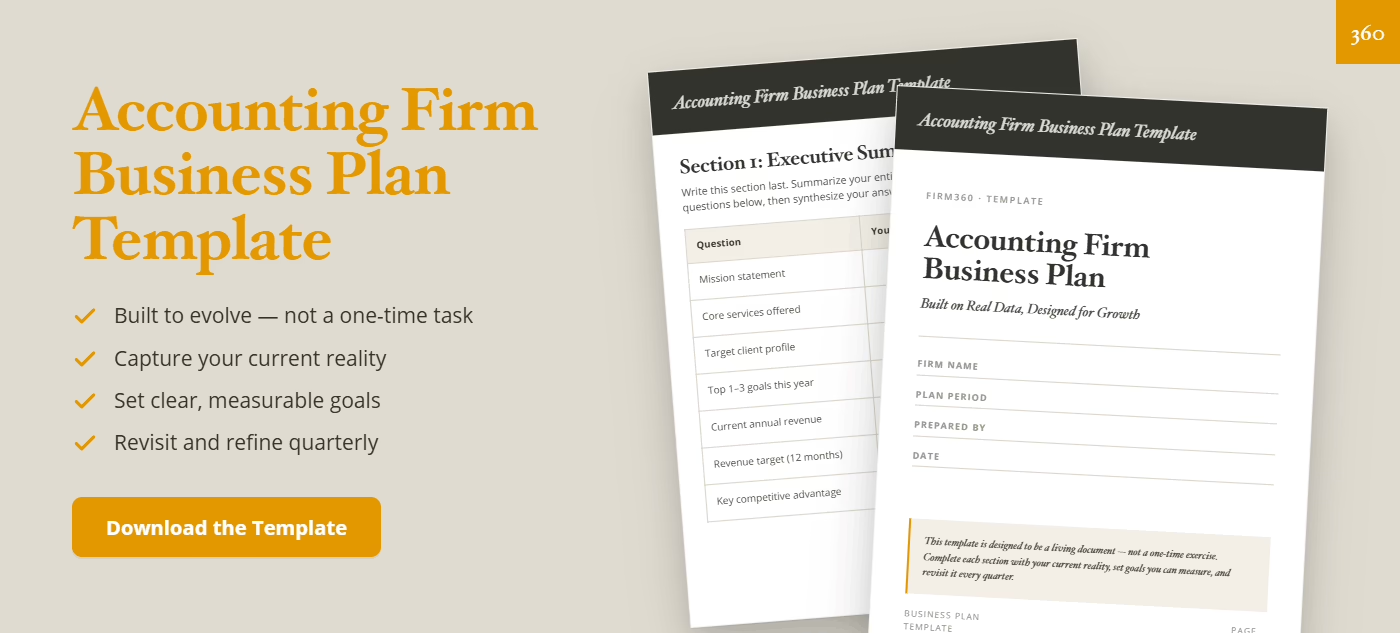
The hardest part of writing a business plan isn’t the strategy. It’s staring at a blank page. The Firm360 Accounting Firm Business Plan Template is built around the same framework in this article — fillable sections for goals and KPIs, realization rate targets, three-year financial projections, capacity planning, and a quarterly review checklist — so you can put your numbers in and start using it right away.
[Download the Free Business Plan Template →]