If succession planning at your firm means a buy-sell agreement with a valuation formula, you’re off to a great start. But paperwork will only take you so far. Regardless of what agreement has been signed, clients still decide who they will trust, knowledge may remain concentrated, and the firm’s real exposure may not have changed.
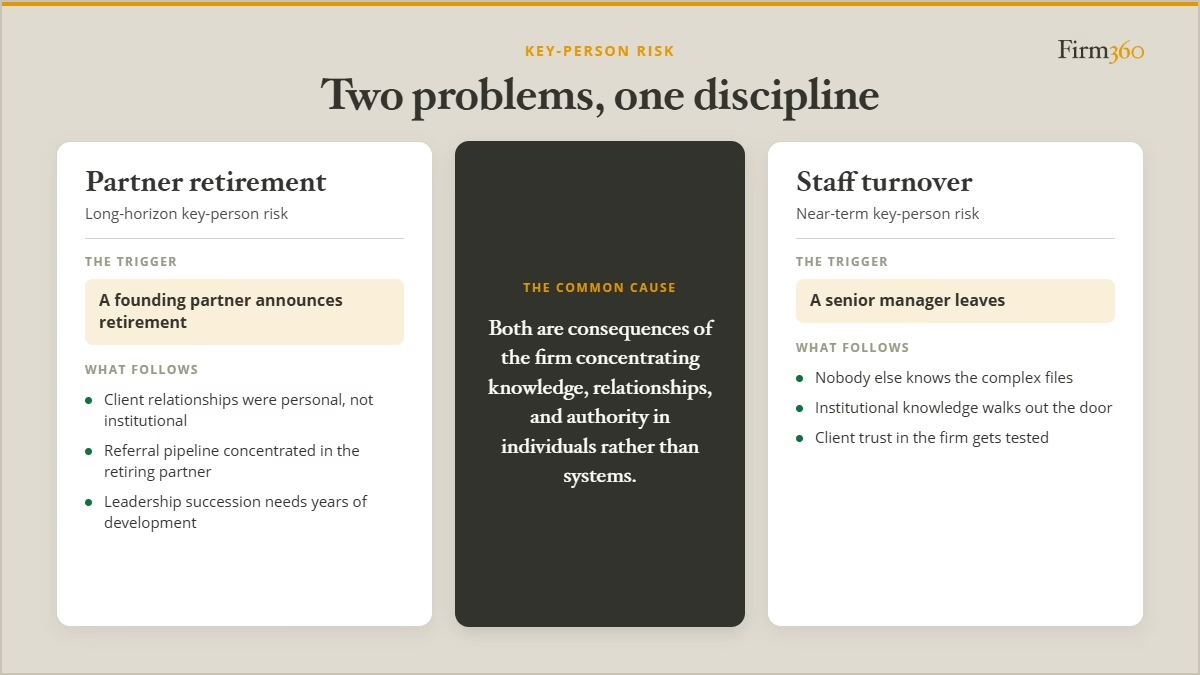
Succession planning is not exclusive to a document. It is a workflow meant to position the firm to continue when leadership changes — the ongoing work, carried out over years, of reducing the firm’s dependence on any single person while developing the next generation of leaders. That reframe connects two problems that look separate. A senior manager resigns in February, and nobody else knows how to run the file for the firm’s most complex client. A founding partner announces retirement, and it turns out the firm’s largest relationships were personal to him. Different timelines, same underlying condition. Both are key-person risk, and both respond to the same discipline.
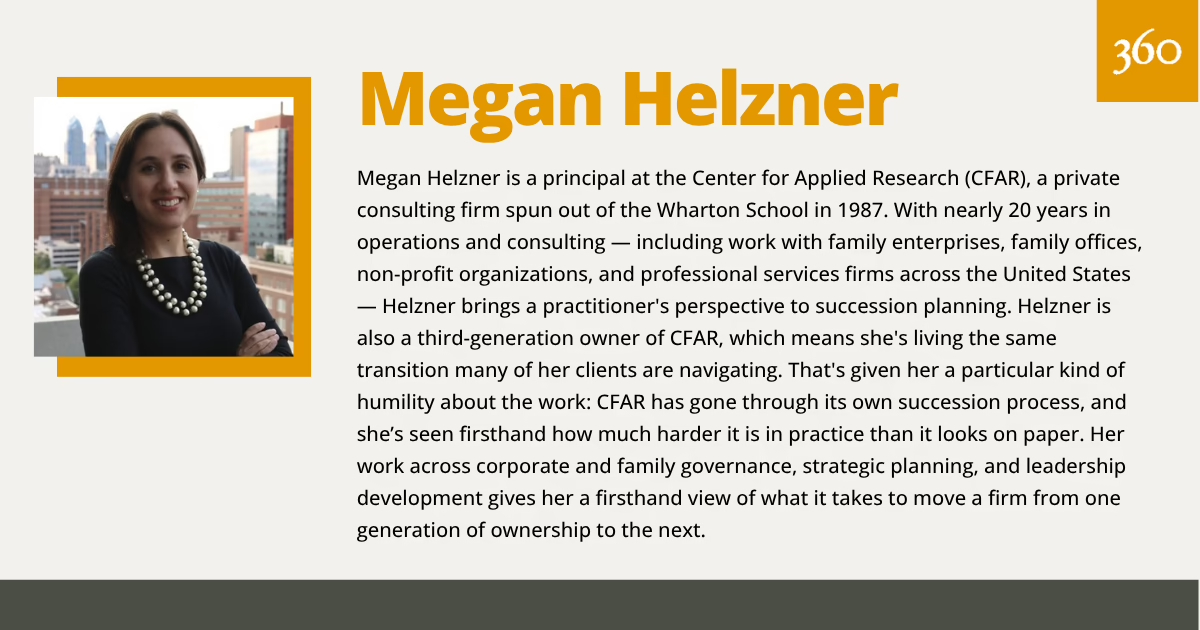
For this guide we spoke with Megan Helzner, a principal at the Center for Applied Research (CFAR), a private consulting firm spun out of the Wharton School in 1987. Helzner advises family enterprises and owner-led businesses on succession planning and governance. Her framing sets the terms:
“Begin thinking about succession planning very early on, not late in the game. You design your organization differently if the intention is to continue.”
What follows treats succession as an operational problem: what key-person risk looks like inside a working firm, how relationships and institutional knowledge actually transfer, and what to do across three horizons. Ownership-transfer mechanics matter too, and they belong earlier on the timeline than most firms assume.
Two Problems, One Discipline
A traditional definition of succession planning for a CPA firm is the transition of client relationships to an internal successor or outside firm, while monetizing the value of the book of business.
Viewed more broadly, succession planning is the ongoing practice of reducing the firm’s dependence on any single person by moving client relationships, technical knowledge and operational authority out of individual heads and into the firm’s systems, documentation and bench. It addresses both near-term staff turnover and long-horizon partner retirement.
Staff turnover is the version most firms have already lived through. Professional staff turnover across firms in Inside Public Accounting (IPA)’s practice management survey fell to 11.8% in 2025, the low end of a 20-year range that peaked at 15.9% during the 2022 hiring crunch. That is real relief for firms that spent several seasons backfilling, but it is not the number that governs succession risk. A firm does not lose 11.8% of a senior manager’s knowledge. Without prior planning, it stands to potentially lose all of it, on one Friday, in one exit conversation.
Partner retirement is the same problem on a longer clock, and the clock is further along than most firms assume. IPA’s 2024 data put the average managing partner age at 55.4, with more than 30% of firms led by a managing partner 60 or older and 12% led by someone 65 or older.
The through-line is concentration. When knowledge, relationships and authority live exclusively in people rather than in systems, every departure takes a piece of the firm with it.
What Gets Overlooked
The obvious succession question is who takes over when the founder retires. Helzner names three things that get less attention, and matter as much.
The first is the firm’s strategic direction. “One piece that can get overlooked is the direction the owners actually want the firm to go in. That deserves a re-commitment whenever there’s a generational change or a significant change in ownership.”
The second is administrative and easy to defer. “Updating key-person insurance is another one.”
The third looks like diligence, which is what makes it hard to see.
“Sometimes the leading generation holds on to things too long instead of starting to share with the next generation, which keeps the next generation from experiencing risk and testing out their leadership skills,” Helzner said. “The next generation needs some skin in the game.”
A partner who keeps the difficult client, the hard conversation and the judgment call is working to protect quality now, but contributing to more difficult succession later.
What Key-Person Risk Actually Looks Like
Key-person risk is easy to agree with in the abstract, but also easy to miss in practice, because it hides inside arrangements that feel like strengths. Helzner describes the tension precisely: “It’s a delicate dance finding the right amount of client interaction with potential successors while maintaining your position as the leading expert.”
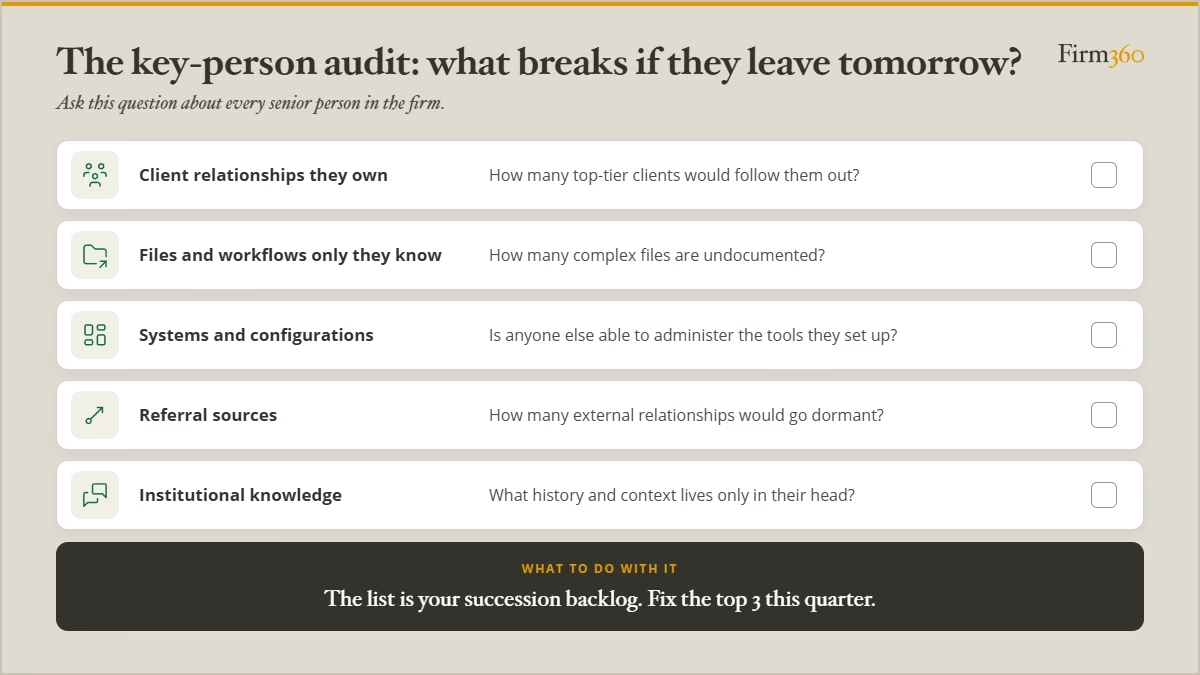
Five patterns recur:
- The client who trusts one partner. The relationship is genuine and decades deep. It is also personal rather than institutional, which means retention is tied to one person’s presence.
- The senior manager who owns the tricky files. The complex consolidations, the multistate returns, the client with the unusual entity structure. The work is excellent, but one-person deep.
- The undocumented exception — “the way we handle this client” knowledge — a workflow that deviates from standard for a reason nobody wrote down.
- The referral relationship. One partner has the ties to the attorney or banker who sends the firm its best work. Lose the partner, lose the pipeline.
- The systems knowledge. Someone configured the tax software, the file structure, the encrypted portal and the e-file settings. Nobody else knows why any of it is set the way it is.
Helzner offers a test that surfaces all five faster than an audit.
“Do things fall apart when that person goes on vacation? Are the relationships transferable when someone else makes the phone call?”
While transferable client relationships are commonly considered, there may be critical referral and vendor relationships that should also be taken into account.
The Client Retention Problem in Succession
Client attrition during a transition is quantifiable enough that it gets priced into how practice sales are underwritten. ABA Advisors, a brokerage specializing in accounting practice sales, reports that “if buyer and seller do what they’re supposed to do from a transition plan standpoint, we see 90% plus client retention.” The same source names what pulls that number down: a single client representing 15% to 20% of revenue leaving, an office that relocates any meaningful distance, and key staff who are not carried through the transition.
Clients rarely leave because of how a transition was announced. They leave because confidence erodes in the months around it. SkillAbility, a CPA firm training and advisory practice, frames the distinction usefully: “A CPA practice transition is not complete when the clients are assigned. It is complete when client trust has transferred.” The erosion signals are ordinary and cumulative — responses slow, the successor sounds unfamiliar with the business, the client repeats history that should already be on file, advice turns inconsistent.
Asked what separates a firm that keeps 90% of its clients from one that loses a third, Helzner starts with culture.
“It starts far in advance of the departure — many years. You need to build a firm culture where it’s about the institution, not the person. Assuming the cost structure allows it, leaders should introduce successors early on, so clients know they’re covered by someone whom they trust and whose skills they’ve seen in action. As a transition is approaching, make plans to alert clients with plenty of advance notice.”
Published guidance puts numbers on that runway. Writing in The Tax Adviser, J. Raleigh Cutrer, CPA/PFS/ABV, and Teela McCullar, CPA, recommend that “the incoming partner or staff should be involved with the retiring partner’s key clients for the two to three years leading up to the retiring partner’s final year.” A one-year runway, they write, is “somewhat abrupt.”
Helzner adds a dimension the timeline alone misses: match the generations on both sides.
“It’s important that the next generation in a family business sees their counterparts in the accounting firm. Think about the next generation on both the client-side and firm-side to increase stickiness.”
The announcement itself requires judgment.
“Provide notice to clients as early as possible. Do it gently — finding a way to make clients feel comfortable with others, in a way that doesn’t turn the departing partner into a lame duck.”
Too late and the transition feels abrupt; too early without structure behind it and the departing partner spends their final years with diminished authority.
Two mechanics carry the rest. Introduce the successor in a joint meeting with every top client — Cutrer and McCullar point to tax season as a natural window. Then shift day-to-day contact gradually while the retiring partner stays visible, so the successor is leading meetings well before the final year.
The Institutional Knowledge Problem
Many firms carry knowledge that exists only in individual people: why a particular client’s workflow deviates from standard, which referral sources send the highest-quality work, what happened during the 2019 audit that still shapes how the engagement is scoped.
Current leadership should capture critical knowledge, especially for technical disciplines, and document the choices leaders have had to make in the moment.
That last clause is the part firms may miss. Technical procedure gets documented; judgment sometimes does not. Helzner suggests a format for recovering it:
“A lot of that institutional knowledge and insight about leaders’ judgment can be pulled out in town-hall-style interviews — asking, for example, how decisions got made during Covid.”
The reasoning behind a hard call is recoverable while the person who made it is still in the building, and only then.
Some knowledge resists documentation entirely.
“The cultural aspects can’t be captured as well in writing,” Helzner says. “You see a lot of leading-generation members who are really good at sales, and those innate skills may be less obvious to the next generation.”
Her answer is not a better document but a different method:
“Doing some workshopping on sales and other skills, and on how to navigate this, is a great knowledge transfer approach.”
Business development transfers by practice, not by memo.
The wrong fix is a comprehensive manual. Firms produce them, nobody reads them, and they go stale within a season. The right fix is smaller and more durable: put the knowledge in the tools people already work in. Client-specific instructions in the client record. Workflow deviations noted on the engagement in the practice management platform. Referral source notes tagged and searchable. Systems configuration documented next to the systems.
The operational principle is easy to apply and hard to argue with. If a piece of knowledge exists only in someone’s head, it is a succession risk. If it exists in the system, it is institutional.
The Valuation Conversation Nobody Starts Early Enough
Knowledge and relationships are not the only things that have to change hands. Equity does too. Have a buy-sell agreement in place at the very beginning.
The buy-sell is where the valuation method lives — and that method should be visible to the people who will one day be on the buying side.
“Expectations don’t always match reality,” Helzer notes.
Success makes the arithmetic harder. “Growth might be great for the leading partners, but it can make buying in hard for new leaders.”
A firm that has compounded value for fifteen years has also compounded the cost of partnership.What blocks the conversation is usually not the math but a norm.
“In smaller firms it can be perceived as a private topic, and there may be a perception that the next generation doesn’t have a right to ask for the information.”
Helzner’s case for transparency runs both ways: “Transparency is important for both sides — the leading generation needs to know the next generation can afford to buy them out.”
A firm that has never discussed it has two generations quietly assuming different numbers.
Succession Planning by Horizon
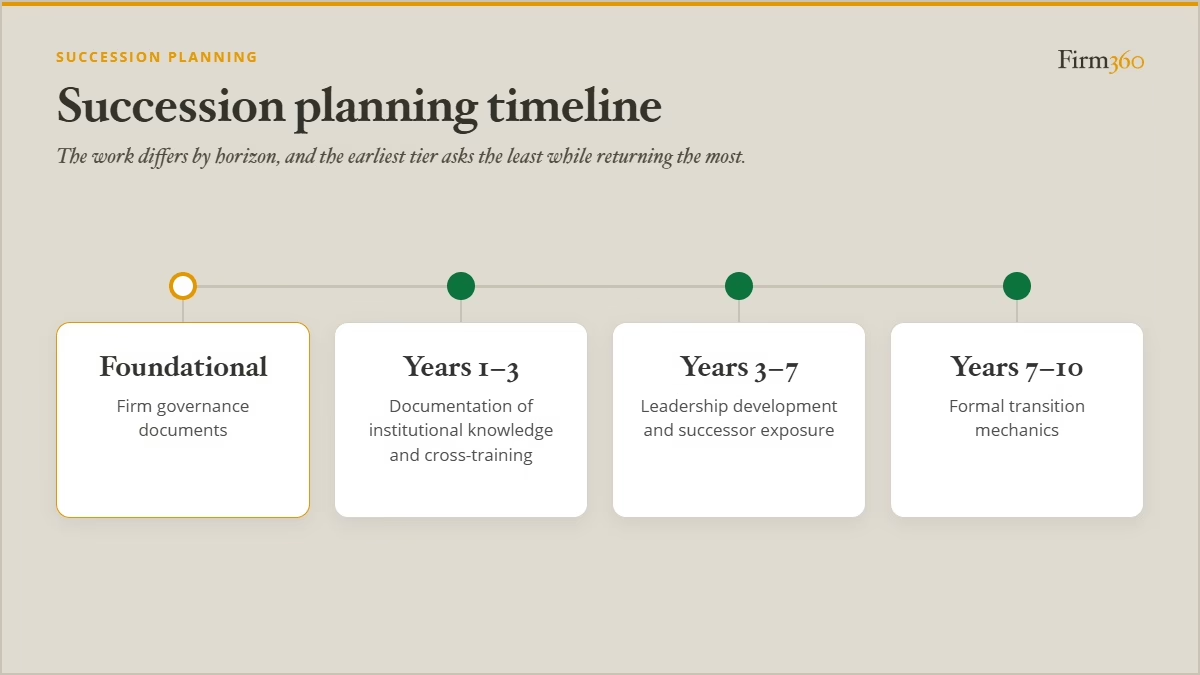
The work of succession planning differs by horizon, and the earliest tier asks the least while returning the most.
Foundational: Before the Timeline Starts
The buy-sell agreement, the operating agreement — if one exists — and the valuation method belong here.
Years 1–3: Documentation and Cross-Training
This tier is available to every firm immediately, whether or not anyone is close to leaving.
Document what lives in individual heads: client-specific instructions, workflow exceptions, systems configurations, referral relationships. Run the town-hall interviews while the people who made the decisions are still there. Cross-train on the complex files, with a standing rule that every complex client has at least two people who can run the work. Standardize the workflows, so the process is defined by the firm rather than by the person executing it.
Review key-person insurance against the firm’s current size rather than the size it was when the policy was written.
Years 3–7: Leadership Development and Successor Exposure
This is the “sits-in” stage. The successor should be in front of clients during this window as part of the team rather than as the announced replacement: present at meetings, copied on the work, known by name. The retiring partner stays the relationship owner, which is what keeps early exposure from reading as a countdown.
Being in the room however, is not the same as being accountable for what happens in it. This window is also where the next generation needs real exposure to risk rather than protected assignments — the skin in the game Helzner mentions.
Development planning also belongs here. “Professional development plans are useful tools — with 360 feedback processes to assess key skills and make sure next-gen leaders are moving in the right direction. Even at the associate level, have these plans in place. You need to constantly upskill.”
Years 7-10: Formal Transition Mechanics
This is the window Cutrer and McCullar name: the two to three years leading up to the retiring partner’s final year. Their sequence is specific.
The incoming partner “should be involved in client meetings, become the main client contact, and begin managing the firm’s relationship with that client” — involvement, then contact, then management, staged across those years rather than settled in one conversation.
Buyout terms and tax structuring get finalized here too, against the valuation method already in the buy-sell agreement.
Where Succession Plans Most Commonly Break
Not starting at all. Asked for the single biggest mistake, Helzner does not pick from the usual list.
“Not doing it. Not talking about it.” The failure mode here is inaction rather than bad execution. “It can be a deeply psychological topic, but putting it off is a mistake.”
Starting too late. Ira Rosenbloom argues in Accounting Today that 55 should be the trigger age, not 65. “At 55, owners are often in a stronger position to adapt, lead change, shape the firm’s future and participate in a transition from a position of strength.”
Set that against IPA’s average managing partner age of 55.4, and a large share of firms are already at the recommended starting line.
Waiting for a perfect plan, or the perfect successor.
“You don’t have to have a perfect plan, and you don’t have to have a chosen leader. It might actually be better to have multiple contenders,” Helzner shares. “It should be about the skills more than the person.”
A firm that names one successor has replaced its old key-person risk with a new one. A firm that develops three against a defined set of skills has a bench.
The plan that was never written down. The AICPA’s PCPS CPA Firm Succession Planning Survey found that 57% of multi-owner firms did not have a written and approved succession plan in place. IPA’s more recent figure runs in the same direction: 41% of firms had a written succession plan for the managing partner role, rising to 63% among firms above $30 million in revenue.
The private conversation. Partners discuss succession in closed rooms while staff and clients fill the silence with speculation about what it means for them.
How Workflow Software Reduces Key-Person Risk
Practice management software does not write a succession plan. It narrows the surface area where key-person risk can hide.
- Standardized workflows. The way work gets done is defined by the system rather than the individual. When a person leaves, the process continues.
- Client information in the platform, not in an inbox. History, preferences, prior-year context and instructions live where the next person can find them.
- Visibility into who does what. When leadership can see workload and client assignment distribution, it can see key-person concentration and rebalance before a departure forces the issue.
- Cross-training that is practical. A documented, system-run workflow is something a second person can pick up.
Every capability above makes the firm less dependent on any one person, which is the whole objective.
A Practical Starting Point for the Managing Partner Reading This
Five actions, none requiring a retirement date on the calendar.
- Move what lives in people’s heads into the practice management system. Standardize your workflows, so the process is defined by the system rather than by the person executing it. Client-specific instructions belong on the client record, workflow exceptions on the engagement, and the reasoning behind a hard call next to the decision it explains. A manual goes stale between seasons; a workflow gets used every day.
- Run the vacation test. For each partner and senior manager, ask what fell apart the last time they were away for two weeks. Then ask whether their relationships would transfer if someone else made the call.
- Check what your buy-sell says about valuation, and who has seen it. If the people expected to buy in have never been shown the method, that is the conversation to open first.
- Open the succession conversation with any partner likely to retire within seven to 10 years. Earlier is better.
- Give the next generation something real. One difficult client, one hard conversation, one judgment call that is genuinely theirs.
Frequently Asked Questions
What is succession planning for a CPA firm?
Succession planning is traditionally defined as transitioning client relationships to an internal successor or outside firm while monetizing the value of the book of business. More broadly, it’s the ongoing practice of reducing a firm’s dependence on any single person — moving client relationships, technical knowledge, and operational authority out of individual heads and into firm systems, documentation, and bench strength.
When should a CPA firm start succession planning?
Succession planning should begin well before a retirement date exists. A buy-sell agreement is a foundational document — with the valuation method spelled out and visible for those likely to buy-in. Documentation and cross-training should run continuously, because they protect against unplanned departures as much as planned ones. For partner transitions specifically, Ira Rosenbloom argues in Accounting Today that 55 is a better trigger age than 65.
Do we need to name a successor?
No. Naming one successor early replaces the firm’s existing key-person risk with a new one. The more durable approach is to define the skills a future leader needs — client development, technical review, staff management, firm-level decision-making — and develop several people against them. Multiple contenders give the firm a bench, and the decision about who leads can be made later without the plan collapsing. A firm built around a single named successor will face difficulties if that person leaves, declines the role, or turns out to be the wrong fit.
How does staff turnover affect succession planning?
Staff turnover is key-person risk on a shorter timeline. When a senior manager who owns the firm’s most complex files leaves, the firm loses that knowledge in full and immediately, without the notice period a partner retirement provides. The mitigations are identical to those for partner succession: document what lives in individual heads, standardize workflows, and make sure at least two people can run every complex engagement.
What percentage of CPA firms have a formal succession plan?
Inside Public Accounting’s 2024 data found 41% of firms had a written succession plan for the managing partner role, rising to 63% among firms above $30 million in revenue.
How do you reduce client attrition during a partner transition?
Start the relationship exposure and transfer years ahead of the exit. The Tax Adviser recommends the incoming partner be involved with the retiring partner’s key clients for the two to three years before the final year. Introduce the successor in joint meetings, shift day-to-day contact gradually while the retiring partner stays available, and give clients a voice rather than an announcement. ABA Advisors reports 90%-plus retention when transition plans are executed properly.
Can practice management software help with succession planning?
Practice management software addresses the operational half of succession planning, which is the half a firm controls directly. Standardized workflows keep a process running when the person who used to run it leaves. Client history, instructions and prior-year context stored in the platform transfer with the file rather than with the individual. Workload and assignment visibility shows leadership where key-person concentration is building, early enough to rebalance. None of that replaces the legal and financial mechanics of an ownership transfer, but it reduces how much those mechanics have to absorb.
Conclusion
Succession planning is a workflow, not a document. The firms that come through a partner transition intact are not necessarily the ones that drafted the best agreement. They are the ones that spent years making themselves less dependent on any single person, so that when the agreement was finally drafted, it recorded a transition that had already largely happened.
Helzner’s answer to the biggest mistake is worth repeating, because it is not a technique. “Not doing it. Not talking about it.” The work is available to any firm, at any point. Standardize the workflows that still depend on one person’s judgment, and document the judgment calls and not only the procedures. Cross-train on the complex files. Move client history out of inboxes and into the practice management system, where the next person can find it. Introduce successors to key relationships years early. Show the next generation how valuation works before they have to ask. The encouraging part is how ordinary the work is — small operational choices that compound.
For a wider view of the systems that support this work, see the Firm360 practice management guide. When you are ready to move client knowledge and firm processes out of individual heads and into a shared system, explore Firm360.
Expert Bio
Megan Helzner is a principal at the Center for Applied Research (CFAR), a private consulting firm spun out of the Wharton School in 1987. With nearly 20 years in operations and consulting — including work with family enterprises, family offices, non-profit organizations, and professional services firms across the United States — Helzner brings a practitioner’s perspective to succession planning.
Helzner is also a third-generation owner of CFAR, which means she’s living the same transition many of her clients are navigating. That’s given her a particular kind of humility about the work: CFAR has gone through its own succession process, and she’s seen firsthand how much harder it is in practice than it looks on paper.
Her work across corporate and family governance, strategic planning, and leadership development gives her a firsthand view of what it takes to move a firm from one generation of ownership to the next.